Public Lecture on Caribbean Politics
Public talk for UCL Caribbean Seminar Series.
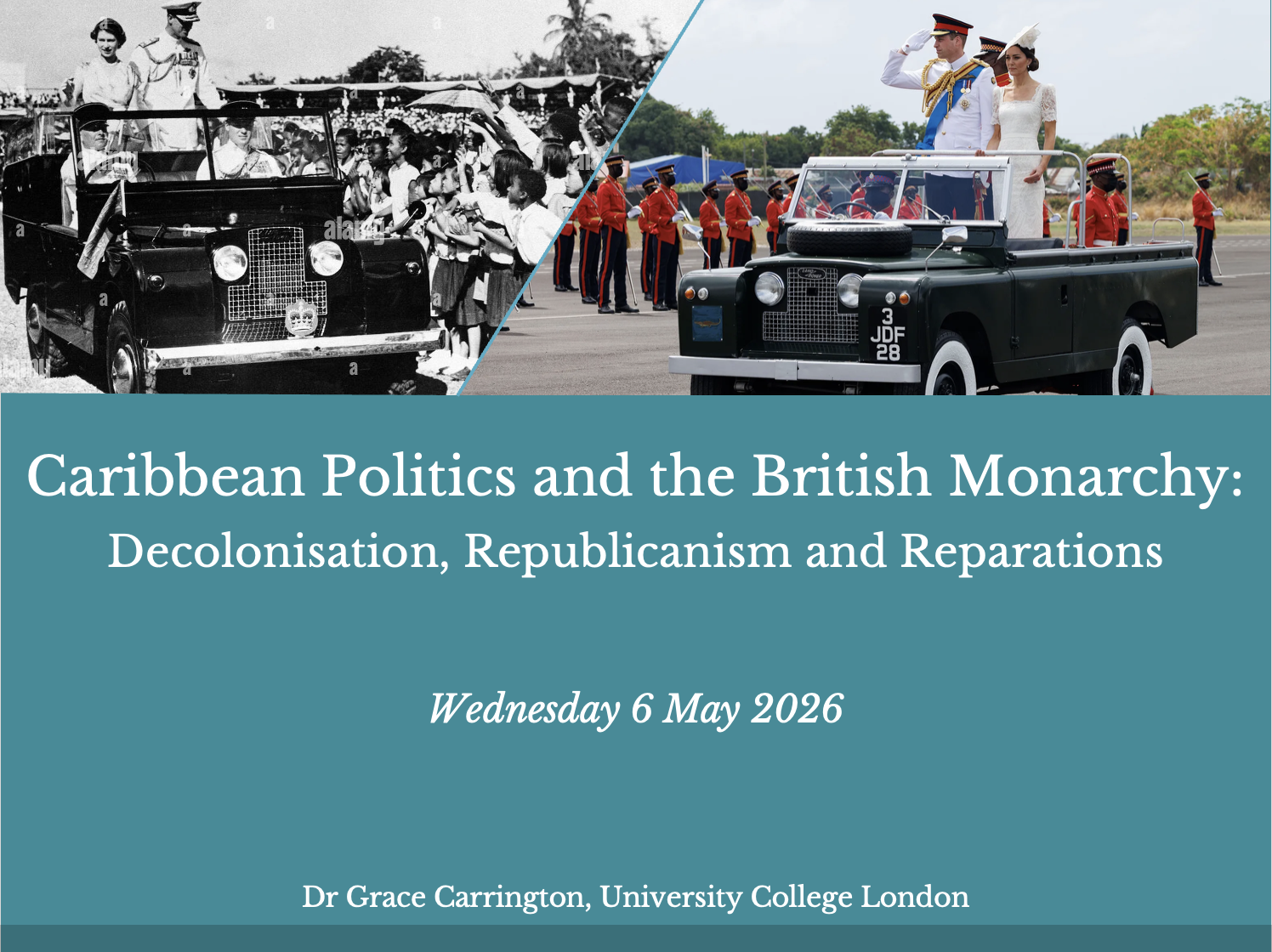
‘Since Barbados’ transition to a republic in 2021, several Caribbean nations have announced their intention to follow suit, prompting renewed scrutiny of the British monarchy’s role in the region. Yet eight independent Caribbean states still recognise the King as head of state. Compared with other regions, the monarchy has proven remarkably durable in the Caribbean, raising important questions about the legacies of colonialism in contemporary political institutions.
Drawing on a current book project, this paper argues that the endurance of the monarchy in the Caribbean is not simply a constitutional inheritance, but the product of deeper social and political structures formed during the colonial period. Focusing on the period from the beginning of Elizabeth II’s reign in 1952 to the present, it examines how hierarchies of race and class became intertwined with monarchical authority, sustaining a colonial order in which Whiteness and Britishness were associated with legitimacy, authority, and wealth. The book investigates the monarchy’s entrenchment in the independence process, its particular prominence in societies with powerful White minorities, and its relationship to land ownership. It also considers the emergence of republican and reparations movements that challenge these legacies.
Through its reputation as a guarantor of stability, impartiality, and respectability, the monarchy helped reproduce racialised notions of political authority in the Caribbean. This legacy persists in the continued reverence for the British honours system as a marker of legitimacy and prestige. Today, even where public support for republicanism is in the majority, constraints embedded in many Caribbean constitutions continue to entrench this colonial inheritance.’